 |
Kaba
A powerful programming languageThe language is a simplified version of c++ with syntax inspired by python. The compiler will generate x86 opcode for execution. 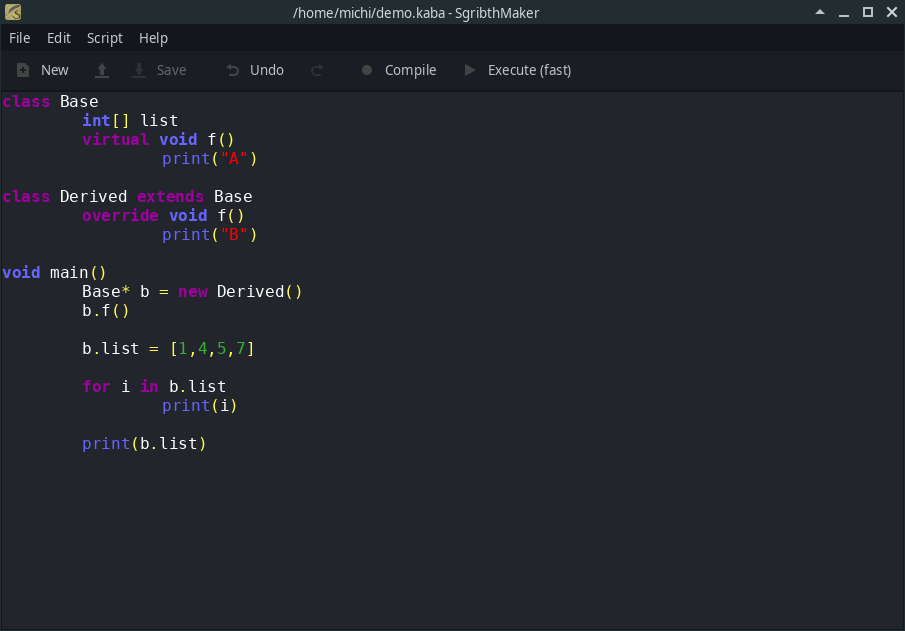 Some language features:
HistoryKaba began as an interpreted script language for the game engine and used C as its syntax. Then came a series of ludicrous adventures of having c++ programs reading and modifying the memory of their own functions during runtime in order to understand how computer architecture works. This lead to a primitive compiler. The first version could only build code by combining predefined blocks. Later an intermediate stage of assembler was added, making the process more complicated but reducing redundancies in the code and allowing to use registers more efficiently. SyntaxSee: wiki:kaba syntax main()Like in c, the starting point is a main() function: func main()
print("hello")
forKaba's dynamic arrays are easier to use than in c++. Also looping over an array behaves like in python: var list: int[] = [1,2,3]
for i in list
print(i)
Although, there is a shortcut when looping over a fixed range: for i in 0:100
print(i)
The type system is c++, but type names are more consistent. Declaring an array is int[] list instead of int list[]! letWhen declaring a variable, the type can be guessed: let list = [1,2,3]
ClassesThe class system works like in c++, also with optional virtual functions. But overriding functions can only be done explicitly: class Base
func virtual f()
print("A")
class Derived extends Base
func override f()
print("B")
Inspired by python, classes can implement operators: class C
i: int
func mut __iadd__(other: C)
i += other.i
Objects can be created on the stack or heap: var a: C
let b = new C()
a.i = b.i
In both cases, elements can be accessed via b.i ("dot") instead of b->i. Exceptionstry
raise(new Exception("bla"))
except Exception as e
pass
Dynamic typesKaba is statically typed but offers a wrapper class for dynamic types: var a: any = dyn([1, "x", [2, true]])
# dictionary
var b: any
b["a"] = "test"
print(b["a"])
LibrariesKaba comes with integrated libraries for graphical user interfaces (gtk backend), 3d graphics (OpenGL and vulken), as well as math (3d linear algebra, fft), networking and threads. A list of all classes and functions can be found here: wiki:kaba reference PlatformsThe compiler can generate (32bit) x86 and amd64 opcode. Some basic features also run on ARM. On linux the code is (mostly) binary compatible with gcc. This means, a c++ program can use kaba to run scripts, have the script create objects and functions and treat those like any regular c++ objects and functions. Also the program can export objects and functions to be used by the script. Windows compatibility (with Visual c++) used to exist, but has not been maintained. |